Showing posts with label Rock and Roll. Show all posts

Friday, July 19, 2013

Chet Flippo

Somehow, I had missed the news last month that Chet Flippo had died at the age of 69.  Although he's probably best known for his writing (and other work) on country music, back in the golden age of Rolling Stone magazine he was the man entrusted to cover Jann S. Wenner's favorite band, the Rolling Stones (in addition to many other profiles, including those of then-obscure artists that he treasured like Willie Nelson and Dolly Parton).  Flippo was there in 1975 in San Antonio when the Stones took one of the most ridiculous publicity photos of all time in front of the Alamo, he was there at the El Mocambo Tavern in Toronto in 1977 when the Stones played one of the more famous club dates in rock history, made all the more so by the fact that Keith was so hooked on heroin that it was even odds whether he'd survive the gig, and he was there in 1978 to get thrown off the tour after Mick blew a gasket over the negative reviews of a Stones show (by Dave Marsh) and "Some Girls" (by Paul Nelson, although it should be noted that Nelson was really just saying the album wasn't up to the standards of their classics).  And, he was there for the triumphant return of Mick and Keith a year later in Canada, when they paid their penance by doing a series of shows for charity.

As time goes by, more and more of the great first generation of rock writers are passing on - Lester Bangs, Paul Nelson, Robert Palmer, and now Flippo.  They were all giants, and they are all missed.

R.I.P.

Sunday, June 30, 2013

Top 6 Albums of the First 6 Months of 2013


And trust me, it was hard to narrow it down to 6.  It's been the best six month stretch in quite a while, and I could easily have stretched it out to 10.  But we'll save that for a year end list.


Jake Bugg


A 19-year old kid, for crying out loud.  Sounds like he's ready to take over the world.

Daft Punk - Random Access Memories


If you still listen to the car radio, good luck not hearing "Get Lucky" if your drive lasts more than 15 minutes.  Fortunately for all of us, it's one of those rare songs that just gets better with repeated listens.  But that's just the tip of the iceberg - this is a remarkable album, one that sounds fresh and new at the same time that it is paying homage to some of the most popular sounds of the seventies.  "Giorgio by Moroder" gives the great producer his due, and "Touch," featuring Paul Williams of all people, is a 9-minute epic that shouldn't work, but does - and to great effect.

John Fogerty - Wrote A Song For Everyone


Only two new songs, but when the covers are some of the best songs that the best American rock ban ever recorded, it's hard to quibble.  The best proof that Fogerty has come to peace with his days in Creedence shows up at the end of the record, when you realize that the opening to the new version of "Proud Mary" owes a lot more to the Ike and Tina version than it does the Creedence original.  The album is full of highlights, and Fogerty isn't afraid to tinker with the originals a bit.  It's hard for me to imagine anyone not liking this album.

Patty Griffin - American Kid


As I wrote a few weeks ago, definitely Griffin's best album since "1000 Kisses," her 2002 masterpiece.

Vampire Weekend - Modern Vampires of the City


I liked their debut a lot, the follow up quite a bit less.  But listening to the new album, unquestionably their best, it's obvious that they were stretching themselves on the second, and that without it the third might not have been possible.  Everything they try on this one - slow, mid-tempo, fast - works.

Yo La Tengo - Fade


Can an indie cult band make their best album after nearly 25 years in the business?  Apparently so.

Tuesday, May 21, 2013

Ray Manzarek

This isn't intended to discount his work with the Doors, which in many (if not most) instances is remarkable, but just to point out that he also made a significant contribution (as producer for several albums, and playing organ in a most memorable way) to the success of X, one of the punk era's greatest bands.

I ranked "Los Angeles" as my 48th favorite album of all time, and in that review wrote this about his work on "The World's A Mess, It's In My Kiss":

And then you reach the album’s last song, and my favorite, “The World’s A Mess, It’s In My Kiss.” This is my favorite song on the album, it’s my favorite song by the band, and it’s one of my favorite songs, period. It contains one of my favorite moments of any song that I’ve heard – the organ solo by Ray Manzarek (of The Doors, who produced the album). At the point the solo begins, John and Exene are trading lines, and then suddenly, the organ takes center stage. All you hear is Zoom’s guitar, Doe’s bass, Bonebrake’s drums, and Manzarek’s incredible organ.

For me, it’s a supremely exciting moment. I’ve heard it hundreds if not thousands of times, and the feeling is always the same. I don’t want it to end, and I feel more alive while it is playing. At that moment, the lyrics and the themes don’t matter. All that is left is the music.

If you haven't heard it, you owe it to yourself to check it out.

Sunday, December 04, 2011

RS Greatest Guitarists

In recent years, Rolling Stone has made a cottage industry out of its “100/500 Best…” issues, which probably says more about Jann Wenner’s point of view than anything else. But I can’t really argue with the premise, because it is entertaining to hear what current artists and critics have to say about the masters of the past.

In the current issue, it’s the “100 Greatest Guitarists of All Time.” While many of these lists are great argument starters, that’s not really the case here, because everyone in the world knew that Jimi Hendrix was the greatest guitarist of all time well before they picked up this magazine. It’s really impossible to argue against the premise of Hendrix as greatest ever, although I suppose it would be fun to see someone try. There’s just no disputing that he did more with less than anyone who’s ever picked up the instrument. Of the albums of his that I own, my favorite is a live recording from Winterland, because it truly shows what he could do at the spur of the moment, in the heat of battle.

Since we got the Clapton cover, I should say a few words about him as well. He comes in at #2 on the list, another choice I won’t quibble with (although I would have been tempted to put Keith Richards there). For a long time I thought Clapton was overrated, because I happened to start buying his albums right around the time (late 1970s) that he was entering into his “mellow” phase. There were certainly some flashes of greatness on “The Fuse” from “Slowhand,” but outside of hearing “Layla” on the radio, I could never quite figure out what all the fuss was about.

What turned my opinion were two performances – one on the “Just One Night” album, where he laid down some incendiary solos on some old Robert Johnson songs; but more than that, a joint appearance on a late night TV show (I can’t even remember which one) with Robert Cray. Cray is an outstanding blues and rock guitarist, and his “Strong Persuader” album may be better than any single album that Clapton has recorded in his career. But that night provided a great opportunity for comparison, because both Cray and Clapton play Fender Stratocasters – so they were on a level playing field, so to speak. And on that night, Clapton just blew Cray away – getting sounds out of his Strat that Cray couldn’t even begin to approach.

As for the rest of the list, I’d say that Jeff Beck, Eddie Van Halen, Joe Walsh and Slash seem ranked a little high, while Neil Young, Prince, Richard Thompson and Lou Reed seem way too low. But that probably says more about my taste in music than anything else. And one other quibble – I might have found room for either Gary Rossington or Allen Collins on the list. “Free Bird,” anyone?

Sunday, May 29, 2011

Gil Scott-Heron

Many of the obituaries for Gil Scott-Heron that I’ve read this weekend refer to him as “the Godfather of Rap” or “the Godfather of Hip-Hop.” While there is truth in both of those claims, each of them strikes me as one of those things that one writes when they’re on a deadline, and don’t have the time to fully delve into what made an artist special.

In the liner notes for the Scott-Heron “Best of” collection released in 1984, Nelson George called him a “keyboardist, poet, singer, rapper, and teller of uncomfortable truths.” For me, that pretty much nails it. You can listen to a Scott-Heron song and be enjoying the melody, and then all of a sudden a phrase or two catches your ear. You pull out the lyric sheet, and you’re no longer enjoying the music in quite the same way. You’re an engaged listener. The work of Scott-Heron was not meant to be disposable; it was meant to make you sit up and take notice…and hopefully, take action.

Well I hate it when the blood starts flowin’
But I’m glad to see resistance growin’

Somebody tell me what’s the word

Tell me, Brother, have you heard from

Johannesburg?

- Johannesburg

It’s worth noting that Scott-Heron released “Johannesburg in 1975, nearly an entire decade before “Artists United Against Apartheid” came together to bring what was happening in South Africa to the attention of the world. In that sense (and others), Scott-Heron was an artist well ahead of his time. It’s also worth noting that “Johannesburg” is a hell of a great party song – stick a bunch of different lyrics in there and hand it over to a group like the Spinners or the O’Jays, and in the mid-seventies you just might have had yourself a #1 song on your hands. So it’s not as if Scott-Heron didn’t know how to make you get out on the dance floor – just listen to “Race Track in France” if you have doubts about that.


What has happened is that in the last 20 years, America has changed from a producer to a consumer. And all consumers know that when the producer names the tune...the consumer has got to dance. That's the way it is. We used to be a producer – very inflexible at that, and now we are consumers and, finding it difficult to understand. Natural resources and minerals will change your world. The Arabs used to be in the 3rd World. They have bought the 2nd World and put a firm down payment on the 1st one. Controlling your resources will control your world. This country has been surprised by the way the world looks now. They don't know if they want to be Matt Dillon or Bob Dylan. They don't know if they want to be diplomats or continue the same policy - of nuclear nightmare diplomacy. John Foster Dulles ain't nothing but the name of an airport now.

- B Movie

Those are not the kind of lyrics you’d seen in any song today, in any genre. You read them and you’re probably thinking to yourself, how can this possibly be something you’d want to listen to? All Scott-Heron needed to turn this into one of the most compelling pieces of political art of the last 40 years was bass and drums. And you don’t even have to agree with what he’s saying – in fact, I’d venture a guess that most people won’t agree with everything he says in this song, and some people won’t agree with anything he says in this song. But you can’t discount the power of the delivery, and the effectiveness of the message.


So many other songs that could be included in a respectful retrospective: “The Bottle, “We Almost Lost Detroit,” and of course the legendary “The Revolution Will Not Be Televised.” But my favorite Scott-Heron song is one of his most mournful – “Winter in America.” It’s a mournful song because it talks about the country that we want to be – and in very painful fashion, peels off the layers to expose the reasons why we’re not quite there yet. And will never be there, frankly; because Utopia doesn’t exist now, and it never will. But that was the brilliance of Gil Scott-Heron – he understood, like a few others before him and since, that only by talking about our faults can we do something about them.

R.I.P.

Friday, April 22, 2011

Rock and Roll Contest!

About which rock and roll legend was the following written:

"She'd been dancing awhile when I first saw her. She walked into that Upper West Side party like a Jersey urchin who'd just inherited Manhattan. All in black - turtleneck and tight black slacks. She seemed more frail than she really was, but not fragile, though you could have counted her ribs, and her jet black hair straggled like waterlogged yarn. Her skin so pale it was nearly translucent, cheeks drawn so tight and thin I was tempted to pull her aside and offer her a decent meal. If only her teeth had been half rotted, she would have passed for Keith Richard's waif sister."

Bonus points if you can identify the author.

Tuesday, April 05, 2011

Kurt Cobain

Kurt Cobain killed himself on my birthday. That is an odd and perhaps morbid thing to remember on a day when you're trying to celebrate, or at least relax, but it really doesn't bother me that much. It's sad, because you're left to wonder, as with other great artists who were gone before their time, what might have happened had things turned out differently.

When I think of Nirvana, I always go back to that autumn day in 1993 when they played live and acoustic on MTV Unplugged. I think it is one of the great live performances in the history of rock and roll. On that night, Kurt Cobain was able to channel the demons that would eventually overtake him and use them to fuel his performance. It was a remarkable performance, all over the map - Bowie, Leadbelly, Meat Puppets, The Vaselines, lesser known Nirvana - a performance that, nearly 20 years later, still gives me goose bumps.

So in honor of a great artist, a song from that performance.


R.I.P.

Friday, March 04, 2011

18 Guitars, A Piano, and One Voice - Jackson Browne, Solo and Acoustic

You keep it up, you try so hard
To keep a life from coming apart
Never know the shallows and the unseen reefs
That are there from the start
In the shape of a heart

“In the Shape of a Heart”

To take the stage accompanied only by a guitar or a piano is a brave thing, and not something that every artist could get away with. Jackson Browne is such an artist, and he’s been doing this sort of thing for close to 50 years now. Never having seen him perform until last night, I can’t say this with any certainty, but I suspect that he’s gotten much better at it as the years have gone by. At this stage of his career, he’s a remarkably self-assured performer, one who is not afraid to hit the occasional bad note (it happens), and then make a self-deprecating joke about it.

Well, I've been up and down this highway
Far as my eyes can see
No matter how fast I run
I can never seem to get away from me

No matter where I am
I can't help thinkin', I'm just a day away
Where I wanna be
Now I'm runnin' home, baby
Like a river to the sea

“Your Bright Baby Blues”

Ultimately, a solo acoustic show comes down to the quality of the songs, and on that score – well, all you really need to know is that Browne is in the Hall of Fame, and it’s largely on the basis of his songwriting. In the solo acoustic setting, Browne doesn’t try to reinvent his songs – it’s not like a Dylan concert where you might sit there listening to a song and think to yourself, “I know I’ve heard that…what is that song?...oh yeah, To Ramona!” (that actually happened to me once). From the first notes of each song, it is clear what you’re hearing. What Browne does in these shows amounts to an in-depth examination of each song – plumbing the depths of the emotions, plumbing the depths of the politics, and plumbing the depths of the humor.

Looking out at the road rushing under my wheels
I don't know how to tell you all just how crazy this life feels
I look around for the friends that I used to turn to, to pull me through
Looking into their eyes I see them running too

“Running on Empty”

What becomes readily apparent over the course of the show is that Browne has never gotten tired of these songs – he sings them with vitality, and as if he had written them just the night before. And the setlist? I couldn’t have come up with a better one myself. He played nearly all of my all-time favorites: “Running on Empty,” “Late For The Sky,” “Sky Blue and Black,” “Your Bright Baby Blues,” and “In the Shape of a Heart.” There were old classics – “Farther On,” “For Everyman,” “For A Dancer.” There were newer songs – “The Barricades of Heaven,” “Going Down To Cuba,” and a brand new one, “If I Could Be Anywhere.” There was a great cover of a great Warren Zevon song, “Don’t Let Us Get Sick.” It was a wonderful mix, frequently interspersed with witty banter and heartfelt stories.

If you ever need holding
Call my name, I'll be there
If you ever need holding
And no holding back, I'll see you through
Sky, sky blue and black

“Sky Blue And Black”

It’s hard to identify one highlight from a night full of them, but if I had to pick just one it would be “Looking East,” which he absolutely killed on the guitar. It should be noted that he is really a hell of a guitar player, and on this song it resulted in a power even greater than that in the original, electric band version.

But whether it be on guitar or piano, Browne has absolutely mastered the solo acoustic format. And being one of rock’s great romantics, it’s a format that serves him and his songs well. If you have a chance to catch him, by all means do so.

Thursday, September 23, 2010

Blast from the Past - PJ Harvey

This post first appeared on August 23, 2006. But now that I've discovered the video is available on YouTube, it seemed worth a revisit. The original title was "Great Random Moments in Rock History:"


Number One:
PJ Harvey on the Tonight Show

I can't pinpoint the exact date, but it was sometime in the early 1990s, probably 92-93.

Polly Jean performed solo that night, and apparently the NBC standards bureau (censors) hadn't taken too close a look at the lyrics of the song she sang, "Rid of Me." She looked great on stage, and began the song, slowly and quietly.

Tie yourself to me
No one else, no
You're not rid of me

One can just imagine Jay sitting at this desk, probably thinking, "oh, a breakup song." The danger in her voice now begins to become apparent, and the guitar gets a little louder.

Night and day I breathe
Hah hah ay hey
You're not rid of me
Yeah you're not rid of me
I beg you my darling
Don't leave me
I'm hurting

And then the bridge, and you're thinking that she can't possibly sing those lines on television, but sure enough, and in the harshest falsetto voice you're ever going to hear.

Lick my legs and I'm on fire
Lick my legs and I'm desire

If Jay is paying attention, it's probably becoming clear to him that the protagonist of this song is not a happy woman. The next verse makes clear just how unhappy.

I'll tie your legs
Keep you against my chest
Oh you're not rid of me
Yeah you're not rid of me
I'll make you lick my injuries
I'm gonna twist your head off, see
Till you say don't you wish you never never met her

Which is probably what Jay was thinking about this time. But, ever the gentleman, there is a brief interview, and the shell-shocked look on Jay's face makes it obvious that by now he's thinking, "what can I possibly ask this woman?"

Amazingly enough, PJ is invited back. But nothing will ever top this, her first appearance on The Tonight Show with Jay Leno.

Friday, July 02, 2010

Farewell, Christgau's Consumer Guide

After 41 years, it appears that Robert Christgau's monthly consumer guide will be no more.

There's only a handful of rock critics that can rightly make a claim for being the most influential of all time - Greil Marcus, Dave Marsh, Lester Bangs (even though he's been dead for almost 30 years), maybe a few others - but there's little doubt that Christgau is at the top of the list.

For most of its life, the Consumer Guide was housed at The Village Voice, which is where I read it religiously from 1978 on. When The Voice bounced Christgau a few years ago, I decided it was finally time to cancel my subscription - even though the magazine had been a shadow of its former self for almost a decade. Fortunately, Christgau landed at Rolling Stone for a while, and the Consumer Guide at MSN.com, although its tenure there was flawed by a maddeningly poor design and poor maneuverability. But that's just quibbling.

Christgau's ability to distill the essence of an album into a few short sentences is the kind of thing that can be good and bad. When done well, as he did it, it was magnificent. But few could do it that well, and when trends start because of a pioneer, you can never be quite sure where they'll lead.

Some of my favorite Christgau reviews:

Dirty Mind, Prince [Warner Bros., 1980]. After going gold in 1979 as an utterly uncrossedover falsetto love man, he takes care of the songwriting, transmutes the persona, revs up the guitar, muscles into the vocals, leans down hard on a rock-steady, funk-tinged four-four, and conceptualizes--about sex, mostly. Thus he becomes the first commercially viable artist in a decade to claim the visionary high ground of Lennon and Dylan and Hendrix (and Jim Morrison), whose rebel turf has been ceded to such marginal heroes-by-fiat as Patti Smith and John Rotten-Lydon. Brashly lubricious where the typical love man plays the lead in "He's So Shy," he specializes here in full-fledged fuckbook fantasies--the kid sleeps with his sister and digs it, sleeps with his girlfriend's boyfriend and doesn't, stops a wedding by gamahuching the bride on her way to church. Mick Jagger should fold up his penis and go home. A

Born in the USA, Bruce Springsteen [Columbia, 1984]. Imperceptible though the movement has been to many sensitive young people, Springsteen has evolved. In fact, this apparent retrenchment is his most rhythmically propulsive, vocally incisive, lyrically balanced, and commercially undeniable album. Even his compulsive studio habits work for him: the aural vibrancy of the thing reminds me like nothing in years that what teenagers loved about rock and roll wasn't that it was catchy or even vibrant but that it just plain sounded good. And while Nebraska's one-note vision may be more left-correct, my instincts (not to mention my leftism) tell me that this uptempo worldview is truer. Hardly ride-off-into-the-sunset stuff, at the same time it's low on nostalgia and beautiful losers. Not counting the title powerhouse, the best songs slip by at first because their tone is so lifelike: the fast-stepping "Working on the Highway," which turns out to be about a country road gang: "Darlington County," which pins down the futility of a macho spree without undercutting its exuberance; and "Glory Days," which finally acknowledges that among other things, getting old is a good joke. A+

Stories From the City, Stories From the Sea, P.J. Harvey [Island, 2000]. If Nirvana and Robert Johnson are rock's essence for you, so's To Bring You My Love. But if you believe the Beatles and George Clinton had more to say in the end, this could be the first PJ album you adore as well as admire. It's a question of whether you use music to face your demons or to vault right over them. Either way the demons will be there, of course, and nobody's claiming they won't catch you by the ankle and bring you down sometime--or that facing them doesn't give you a shot at running them the fuck over. Maybe that's how Harvey got to where she could enjoy the fruits of her own genius and sexuality. Or maybe she just met the right guy. Tempos and pudendum juiced, she feels the world ending and feels immortal on the very first track. The other 11 songs she takes from there. A+

Wednesday, April 28, 2010

The Avett Brothers at The Crest

When it comes to Avett Brothers fandom, I'm strictly a newbie. Less than a year ago, I'd never heard of them. A friend at work recommended them as someone I might like, so I checked out a few tunes on YouTube, and liked what I heard. Bought their 2009 album, "I And Love And You," and thought it was great - ranked it #2 on my list of 2009 favorites. Recently bought an older EP, "The Gleam II," but barely had a chance to listen to it, caught in the midst of my Drive-By Truckers obsession.
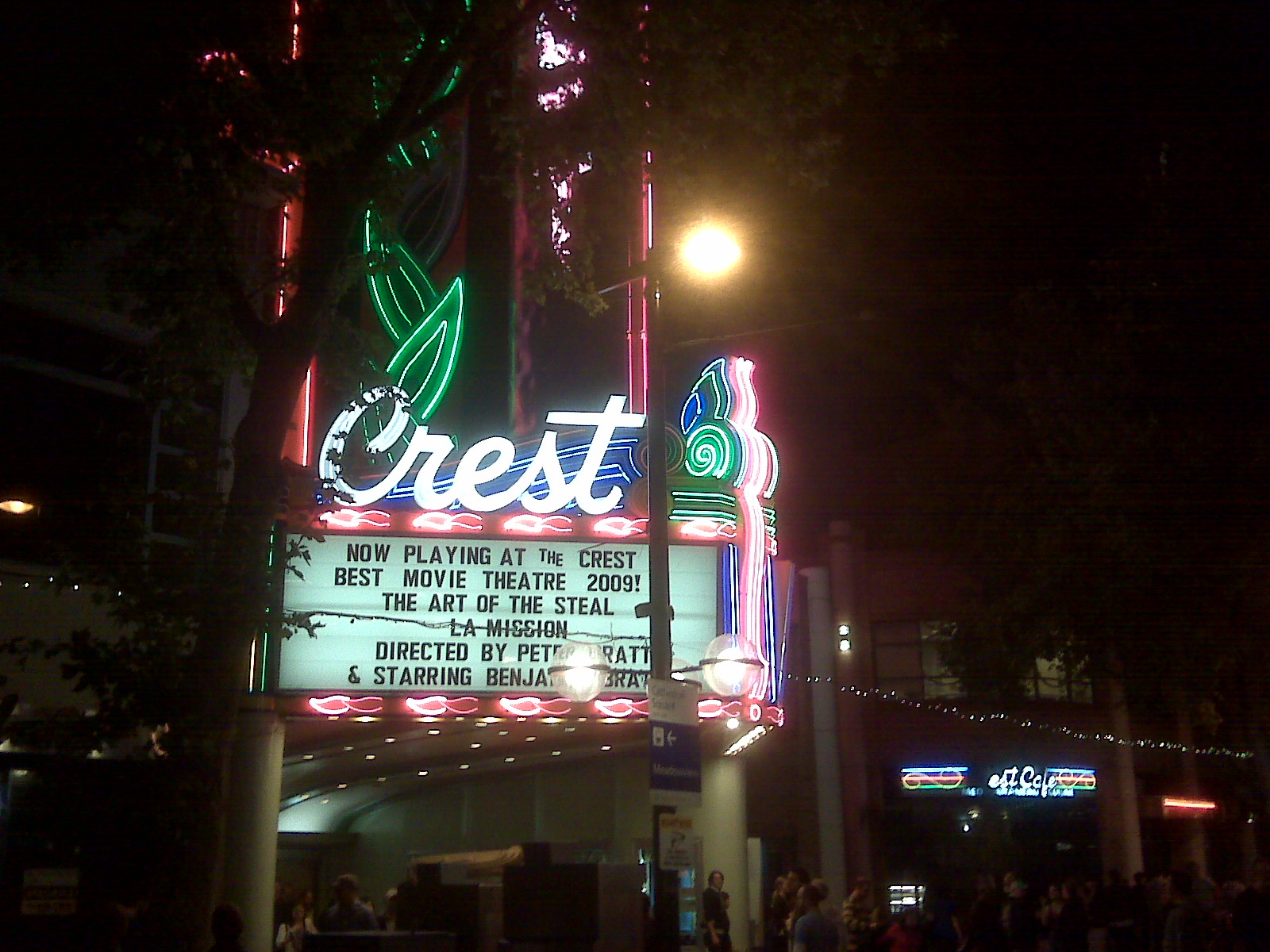
Heading into last night's show, I was expecting to be entertained, but I'm not sure I expected to be blown away like I was. It was an amazing show from start to finish - one filled with humor, energy, passion, and great music. And it wasn't as if we were familiar with the songs - only 5 of the 19 they played were from the new album, but it was obvious that most of the crowd knew them all.

And who knew that Sacramento, California was such a hotbed of Avett mania? Sure, we're only talking about a theater that probably holds less than 2000 people. On the same night, The Eagles played at Arco Arena, in front of what was probably close to 17,000 patrons. I'm sure it was a great show, but I'm just as sure (and mind you, I am an Eagles fan) that Glenn Frey and Don Henley never had as much energy on their best days in the 1970s as the Avetts do today. As it turns out, the Avetts do have a Sacramento connection (an uncle), and one of the highlights of the show was an anecdote about a show many years ago in Fair Oaks (for those of you unfamiliar with the Sacramento region, Fair Oaks is a suburb of the capital city, and just happens to be where I spent my formative years) where there were more chickens in the audience than there were paying customers. Now, that may only make sense to someone who's been to Fair Oaks, but it was an example of the bond that the band had with its audience.

It's fair to say that nothing on "I And Love And You," good as it was, prepared me for the energy demonstrated by the brothers and their band in concert. There's plenty of live clips on YouTube to check out if one so desires (including quite a few of last night's show, just enter "Avett Brothers Sacramento" in the search bar), but even having seen Springsteen as often as I have, I'm not sure I've ever seen performers maintain a sustained energy level for as long as the Avetts did last night.

I'm lucky to have seen two shows as great as DBT and the Avetts in the past month, and they both reminded me of the importance that music holds in my life. I don't play an instrument, though I suppose it's never to late to try, but my music collection is huge (probably vast by the standards of most normal people), and put simply, I can't imagine a life without music. On a day when things look their darkest, the redeeming power of a musical artist like The Avett Brothers is a wonderful thing. Sitting there last night, listening to the sincerity and the humor that are such key components in the songs of the Avetts, seeing the bond they have with their audience, and seeing the passion that their audience has for their work...well, for those moments, everything was right with the world.

A joyful noise is probably the best way to put it - beautiful vocals (even when almost screaming, they were able to maintain perfect harmony, conjuring up visions of the Everly Brothers), a bass that thundered so loud it shook the very core of your being, a banjo that, even when slightly out of tune (and, as was noted, it is damn near impossible to keep a banjo in tune, especially the way that Scott Avett plays it), terrific acoustic guitar, and even a cello, which is not something you normally hear in a band, unless it's playing in tuxedos.

Great stuff. Hope they come around again someday.

Thursday, April 15, 2010

New Blog Feature: "Now Playing"

One of these days, I'm actually going to figure out all of the capabilities of this here blog. But for now, baby steps are the order of the day.

Today's new feature, over there on the right, is the "Now Playing" box, courtesy of Lala. In it, I will feature a current object of obsession, which right now would be the Drive-By Truckers. Less than six months ago, I had never heard of the band, which is to my own discredit. Now, they are threatening to become my favorite band. I just saw them during my trip to Chicago, and suspect that more concerts are in the future.

On tap right now is their album "The Fine Print," which is billed as a "collection of rarities and oddities, 2003-2008." It's all great stuff, but in particular I want to highlight two cover versions: Tom T. Hall's "Mama Bake A Pie (Daddy Kill A Chicken)," and Dylan's "Like A Rolling Stone."

Enjoy!

Friday, January 08, 2010

The One and Only King


You could call this the greatest band in the history of rock and roll, and you wouldn't get an argument from me.

You could call the performances that Elvis gave on this night the greatest performances in the history of rock and roll, and you wouldn't get an argument from me.

Happy Birthday, Elvis.

Tuesday, January 05, 2010

Willie Mitchell

Willie Mitchell died today. If you’ve never heard of him, he was one of the great soul music producers of his time (or any time), and he produced these two songs (among many others):


Even if it were just those two songs, that would be enough.

Monday, September 14, 2009

Jim Carroll R.I.P.


There were a handful of songs that defined my first year of college: Talking Heads' "Once in a Lifetime," X's "Los Angeles," The English Beat's "Twist and Shout," Pretenders' "Precious," Bruce Springsteen's "The River..."

And this one - "People Who Died," by Jim Carroll.

And now Jim Carroll has died, of a heart attack at age 60. He was never a huge star, but people will be listening to this song for as long as they listen to music.

Wednesday, July 29, 2009

Four Albums

For the last couple of days, I've been listening in the car to a tape that I made a few years ago which features highlights from the first four Talking Heads albums, which were released, one per year, beginning in 1977: Talking Heads '77, More Songs About Buildings And Food, Fear of Music, and Remain in Light.

Listening now, there are several things that are hard to believe - one, that it was 30 years ago (give or take a year) that this music was recorded. Second, that the band was able to produce four albums in as many years as brilliant as those four. But most importantly, that the band was able to make four albums that sound as different in their sound as those four. Though all four are easily identifiable as Talking Heads, they each have a distinct identity - none of them sound like the others.


On Talking Heads '77, the production was spare, and the band sounded (and looked, as evident in the above video) innocent, almost naive.


On More Songs About Buildings and Food, the band was produced by Brian Eno, who could almost be called "the fifth head." The sound was much fuller, and the band sounded a lot more confident than on their debut, almost as if they had begun to realize just how good they were.


Eno was still there behind the boards on Fear of Music, but the album's sound was an 180 degree turn away from its predecessor - where Buildings and Food's sound was full and warm, Fear of Music was ice cold - a perfect match to the music the band was now making. Nervous, edgy music - you could (and still can) dance to it, but you'd be just as likely to want to hit something.


And then came what is probably the band's masterpiece. There was so much going on that it wasn't easy to get into at first listen, but ultimately it was one of those few albums where a band was able to stretch itself to reach all the ambitions it ever had, and execute them perfectly. And this was definitely not the same Talking Heads that audiences had seen in 1977. Augmented by expert musicians like Adrian Belew, Busta Jones, Steve Scales and Nona Hendryx, Byrne and his bandmates - Jerry Harrison, Tina Weymouth, and Chris Frantz - proved themselves to be showmen of the first order. It was this version of the band that I saw perform in October 1980, and it remains one of the concert highlights of my life.

One band, four years, four wonderful albums.

Thursday, June 25, 2009

Michael Jackson

Well, who knew that my first post back from vacation would be about the death of Michael Jackson, which shocked me like no rock death since that of John Lennon. I can't imagine what the cable airwaves are going to be like in the next 24 hours - I'm sure that it will be even worse than Elvis' death, when every Tom, Dick and Harry who had crossed paths with the King came out of the woodwork to pontificate on how avoidable it all was, how sad it was that Elvis had allowed himself to sink so far - when most of those uttering those words had enabled him for years.

The less said about Michael's travails over the past two decades, the better. The story is well known, and it is not a happy one. All you really need to know is that in 1985 - nearly twenty-five years ago! - Dave Marsh wrote "Trapped," a book about Michael, with the thesis that Michael was "shackled by his fame and his inability to portray himself honestly to his audience." And that was before things truly went downhill.

In my book, it certainly qualifies as a tragic story - because at one time, it seemed that Michael was poised to conquer all before him, was prepared to create music with the potential to cross-over, to unite. That it didn't happen is reason enough to mourn his passing.

UPDATE: Steven Rubio also equates Michael's death with Elvis', quoting words from Lester Bangs that I've quoted here before.

Sunday, May 24, 2009

Happy Birthday, Rosanne and Bob

It so happens that today is the birthday of two of my pantheon artists, Rosanne Cash and Bob Dylan. Wherever they are, I hope they're having a great time.


Friday, May 08, 2009

CCR

Listening to my Creedence tape on the way into work this morning, once again I was in awe of what the band was able to accomplish in such a short time. How one band - one man, really - come up with so many great songs in such a short period of time?

It's hard, if not impossible, to identify one single song as their best. But my favorite, since I was nine years old and look forward to hearing it every week on American Bandstand, is "Green River." The perfect example of their sound - even now, I can't figure out all the lyrics, except for this killer fragment at the end:

Old Brodie Junior took me over
Said you're gonna find the world is smolderin'
If you get lost
Come on home to Green River

What made Creedence was the sound - and that sound; dangerous and somewhat mysterious, never got better than it did on "Green River."